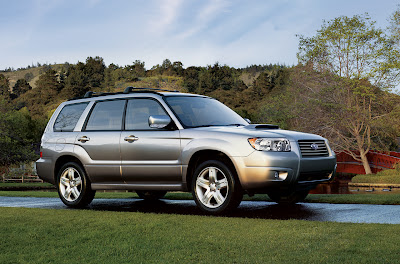
Showing posts with label Subaru. Show all posts

Saturday, February 5, 2011

Subaru Outback - suprising capability

It was Thanksgiving week and necessary to transport a lot food, cooked and uncooked, over bumpy roads, through the woods, over rough bridges, and along twisty roads. Fortunately, it was a 2011 Subaru Outback that had been made available for a test drive.

The name alone gives you an indication of how this vehicle can be utilized. All Subaru cars are All-Wheel-Drive, and that four-wheel drive ability is really useful. It allows the Subaru Outback to really go out into the outback areas and do almost any type off-roading except the extreme style reserved for Jeep, Land Rover, and Hummer.

The Outback is now in its fourth generation, but in 2010, it was re-designed. Apparently, the design engineers at Subaru got it right this time. They increased the back seat, upgraded some of the interior, and stayed with the basics – capability, utility, drivability. The initial Outback models were simply a spin-off of the Legacy station wagon. Wagons are not very popular with certain age groups. But now, the Outback, with its redesign, is competing directly against the Honda Accord Crosstour and the Toyota Venza and outselling them in most instances.


Out test model was a beautiful Cypress Green Pearl. We did not drive it down into the Lousiana bayous, but we did take it into the East Texas Piney Woods. The cypress green color blended nicely with the abundant pine trees. There are three trim levels available: Base, Premium, and Limited. Our test model was the Limited, which included a lot more comfort and convenience features, but the price was also slightly higher.


The Subaru Outback is powered by either a four cylinder engine or a 3.6 liter 6-cylinder. The 6 cylinder definitely had a lot of get-up-and-go and never even hiccoughed. I am sure, however, that the four cylinder engine would do the job necessary in almost any situation, however. The 6 cylinder engine was matched with a five speed automatic transmission that operated smoothly and efficiently. The Outback provided good steering and handling, and turned easily along the winding East Texas back roads. It bounced along the uneven dirt roads without much driver disturbance.


The Subaru Outback is an SUV, but also a Crossover, based on a car platform. The redesign was introduced at the 2009 New York Auto Show and I was impressed then, but I really like the improvements and upgrades in this latest model. It is a fairly heavy sedan style, although it is an SUV. The body is made with high tensile steel and that gives it top ratings in crash tests.


The base MSRP of the Outback Limited with the 6 cylinder engine is $31,495. Pricing for the Outback begins about $23 to $24 thousand. There are a lot of options and packages available and with a few of these added on, the bottom sticker price on the test model came to $33,724. EPA mileage ratings were 18 cities and 25 highway.


If you are thinking about a small SUV that is versatile and can go almost anywhere and do almost anything try this one. You might be very surprised at the capability of this vehicle.

Subaru Tribeca - Surefooted and solid

TriBeCa – it’s actually the name of a well-known neighborhood in Lower Manhattan made popular by actors like Robert DeNiro, and means "Triangle below Canal Street."
But in 2006, Subaru decided the mid-size SUV neighborhood needed a new resident, and introduced its first big one, also called Tribeca.


Using the name of a New York City neighborhood for a very mainstream vehicle aimed at the suburbs was just one of those idiosyncrasies of a company that used to be known for its niche vehicles. But built on the mid-size Legacy sedan platform, it offered more room (up to seven seats) than any Subie before, plus the ever-present all-wheel-drive, definitely aiming it toward those more used to Chevrolets and Toyotas.
For 2011, the Tribeca remains much the same as it has for the past two years since a mild refreshing of exterior design for 2008. So let’s check out the neighborhood and see how our Tribeca 3.6R Touring stacks up.


· Subaru splendor – When the Tribeca was introduced in 2006, it came with a – shall we say – unique grill. It was kind of like an upside down Alfa Romeo V grill with flanking wing-like inlets under slash headlights, while a gentle beltline accent became the rear fender line that flowed into the taillights. For 2008, that odd grill was replaced with the current mainstream face of Subaru, a 3-bar design under a chrome strip with larger quad headlights that wrap into the fenders, with a slim mid-bumper air intake and a wider lower mouth intake with a faux aluminum brush guard accent and fog lamps at the bottom. A matte body color accent on gentle fender flares frames 18-inch Goodyear Eagle radials on simple 7-spoke alloys. The windshield pillar gets a tiny fake vent window, just enough to lighten the thick look inside and out, plus big body color and black side mirrors with turn signal repeaters. The only jewelry on the flanks are chrome door handles and a body-color strip, as the lower window lines rises slightly toward a junction with the D-pillar, the original tapered rear fender line still evident as it widens to meet the large taillights. A simple semi-step rear bumper with reflectors gets twin chrome-tipped exhausts, while the rear hatch is wide with a wind deflector atop the tinted rear window, twin silver roof bars offering the only other design touch. It’s a simple design, one that no one gave a second look at, but which was clean and quiet on the highway with little wind noise.


· Tribeca transport – As simple as the exterior looks, a Tribeca interior is a pretty upscale and flowing place to be, but doesn’t look all that different from the last one I tested years ago. That’s just fine, because it works. The black over tan design, with silver center bar, flows around the driver and passenger, surging in between them to put the most-used climate and audio controls in easy reach of both. Under a hard (but matte leather-grained) plastic cowl sits two inset analog gauges, a 150-mph speedometer and 8,000-rpm tach, ringed in red at night. White LCD gas and temperature gauges flank the pod, while power mirror, plus HID headlight dip angle controls reside to the lower left of the tilt-adjustable leather-wrapped steering wheel, which has basic stereo and cruise controls. Set back in its own black dash center frame is a decent-size LCD touch screen for the satellite navigation, trip computer and 385-watt AM-FM-XM Satellite-CD harmon-kardon sound system, its center speaker mounted just in front over basic stereo/navigation/computer controls. The silver dash center section centers on a big stereo volume knob flanked by audio function and select buttons. Novel dual-zone temperature controls and a fan speed control frame temperature and fan/mode displays, but felt a bit flimsy. Silver mode and seat heater buttons sit at the dash center’s base forward of the 5-speed automatic gearshifter and two big (hidden) illuminated cup holders and cellphone/MP3 player slots under silver doors. The bucket seats, 8-way power driver and 4-way power passenger, were comfortable and fairly supportive on trips, both getting manual lumbar support. The glove box is big enough, as are the hard plastic door map pockets, while there’s decent storage and twin 12-volt outlet and an MP3 input jack under the padded center armrest. All controls are red lit at night, with an overhead red LED spotlight to illuminate the center dash. Bluetooth cellphone buttons and microphone live overhead, with the sunroof control. The back doors open wide to a leather-clad second-row seat with adjustable recline and a center armrest, plus our tester’s optional rear-seat entertainment system with nine-inch wide-screen format LCD screen and a DVD player with remote inputs for video games and a video camera. There were two wireless headphones and a wireless remote control for the clear video system, plus a rear a/c fan control. All Tribecas now have a 7-seat configuration. To fit in a third row, the second row’s leg room was tight for teens and adults, even though it can slide fore/aft. It’s also a bit tight to get to the third row seats, even though the second row seats fold and slide forward. Once there, legroom/foot room was minimal for anyone over 12, although headroom was fine, and there are fender well-mounted cup holders, A/V inputs and overhead rear a/c vents. Nice touch - molded grab handles on the lower C-pillar are there as you get into the third row seat, while a simple clip holds the second-row seat belts out of the way. Cargo space is usable (8.3-cu.ft.) behind the third-row seats, with some hidden storage under the floor. Dropping the third row and their integral head restraints expands it to 37.6-cu.ft, and dropping the second row doubles that, with four steel tie-down loops. But I found that with the LCD screen down and second- or third-row head restraints up, rearward vision was reduced.
· Tribeca traveling – Power for our mid-size SUV comes from a 3.6-liter, 256-hp Boxer Six (think classic Porsche 911-like horizontally-opposed design). It offered a lot of low- and mid-range punch, and launched our 4,256-lb. SUV to 60-mph in a decent 7.8-seconds when the 5-speed automatic was in Sport mode. Fuel mileage on regular was about 19-mpg. With 4-wheel independent suspension and all-wheel-drive, the Tribeca was a secure driver in dry or rainy weather, only betrayed by a slightly soft suspension tune and some body roll in turns. Push into a turn, and the 20-year tradition of all-wheel-drive in Subies is appreciated as Variable Torque Distribution from the planetary gear-type center differential and electronically controlled hydraulic transfer clutch control power distribution between the front and rear wheels. Normally, the torque split is 45/55, with a rearward bias. But push harder, and we detected some front wheel action that did neutralize the understeer a bit. That said, it’s sure-footed if not as sporty as some other mid-size crossovers we could name. We didn’t go off road, but it can probably handle most soccer dad grassy fields and beaches. The power steering had a nice feel, and the all-wheel disc brakes stopped us fine with minimal nose dive and only a slight hint of fade after some repeated hard use. Add an accessory towing package, and the Tribeca handles up to 3,500 pounds of trailer.


· Subaru salary - The base Tribeca starts at $30,495, with Symmetrical All-Wheel Drive, dual-zone automatic climate control and 3-stage heated front seats. Our Tribeca 3.6R Touring, the range-topper as of 2010, starts at $35,620, with a well-applied Azurite Blue Pearl paint, leather seats, a 10-speaker Harman kardon audio system, rear a/c, 2-position driver's seat memory, power tilt/sliding-glass moonroof, rear-vision camera and 7-spoke alloy wheels. Standard Bluetooth hands-free phone is also standard, as is XM satellite radio, while a navigation and entertainment package with DVD video player and wide-screen LCD monitor added $4,000. Final price - $40,520. Competition like the Chevrolet Traverse (288-hp) and Hyundai Santa Fe (276-hp) have more power, slightly better fuel mileage, and better second row leg room. The Traverse is longer and roomier overall, the Santa Fe less expensive and lighter. And a Toyota Highlander, with 270-hp and a base price of about $33,000, is lighter, slightly shorter and also offers more second row leg room as well. These are just a few of the many mid-size SUV options out there. For safety, dual-stage driver and passenger airbags, front seat-mounted side impact air bags and standard curtain side air bags front and second rows.
· Bottom line - Built at the Subaru plant in Lafayette, Indiana, the Tribeca is a solid, handsome, sure-footed family vehicle with good value, power, road-holding and OK fuel mileage. It was well built to boot. But it isn’t as roomy as it could be if maybe those third row seats had been ditched and the second row moved aft a bit. And it isn’t a sporty driver, although it is very capable in all the weather we drove it through. Just like a Subaru, it is a sensible choice, but it needs a bit of updating.


2011 Subaru Tribeca Touring
Vehicle type - 7-passenger crossover SUV
Base price - $35,620 ($40,520 as tested)
Engine type – Horizontally-opposed DOHC, 24-valve aluminum block 6-cylinder
Displacement – 3.6 liters
Horsepower (net) – 256 @ 6,000 rpm
Torque (lb-ft) – 247 @ 4,400 rpm
Transmission – 5-speed automatic with manual shifting and Sport setting
Wheelbase – 108.2 inches
Overall length – 191.5 inches
Overall width – 88.8 inches w/mirrors
Height – 66.7 inches
Front headroom – 38.9 inches
Front legroom – 42.3 inches
Second row headroom – 38.2 inches
Second row legroom – 34.3 inches
Rear headroom – 36.2 inches
Rear legroom – 30.9 inches
Cargo capacity – 8.3 cu. ft./37.6 w/2nd row folded/ 74.4 w/2nd and 3rd row folded
Towing - up to 3,500 lbs.
Curb weight – 4,256 lbs.
Fuel capacity – 16.9 gallons
Mileage rating - 16 mpg city/21 mpg highway
Last word – Solid, comfortable - a sure-footed Subaru

Tuesday, September 22, 2009

Subaru


Subaru BajaSubaru Baja
Subaru Outback2008 Subaru Outback
Subaru Forester2007 Subaru Forester

2010 Subaru Legacy wallpaper
Subaru Wrx Sti
Subaru ImprezaFrench police crashed Subaru Impreza
SubaruSubaru Impreza WRX
Subaru Impreza Wrx


Subaru History
The word "Subaru"is the name in Japanese, the Pleiades star cluster, which is represented on the company logo. Despite Subaru being a small company in the automotive sector, compared with many of its competitors, Subaru has been a highly profitable company for many years. It is notable for its production of conventional cars (three-volume, station wagon / van and "hatch") with 4X4 wheel drive (in fact, in many markets it serves, the only supply vehicles of the brand is available with this type of traction , Besides using boxer engine with 4 cylinders opposite pairs.
The vehicles are known in the Subaru turbocharged versions of the Legacy and Impreza models. Modified versions of its model WRX and Subaru Impreza WRX STi have been competing for years with success in rally events, such as the World Rally Championship.
Recently, Toyota bought the stake that GM had about Subaru, and created a technology alliance in which they share several components. While Toyota will use Subaru's factories in the United States, the Subaru will use Toyota hybrid to technology. On April 10, 2008 Toyota and Fuji Heavy Industries, Subaru's parent, announced a deepening of its cooperation program, which will encompass the joint development of a sporty compact models and providing for Subaru .


Friday, June 12, 2009

Subaru Impreza Car Pictures

Subaru Impreza
Subaru Impreza

Subaru Impreza Car
Subaru Impreza Car

Subaru Impreza Picture

The Subaru Impreza is a compact car that was first introduced by Subaru in 1993.

"Impreza" is a coined word, deriving from an originally Italian word, impresa, meaning a feat or achievement. In Polish, "Impreza" means "party", "event" or "show".

The Impreza was introduced after the popular Leone/Loyale was cancelled with the aging EA series engine. The Impreza was introduced with the popular EJ series engine found in the larger Subaru Legacy.

Subaru is the only company that can claim that their drivetrain is symmetrical for this class size of vehicle.
Compared to vehicles in a similar size class such as Toyota Corolla, Honda Civic, Nissan Sentra, Hyundai Elantra and Mazda Protegé/Mazda3, only the Impreza has always offered AWD, and as of 1996 Subaru made this feature standard equipment in some markets. Subaru produces a lower volume of slightly upscale, well-equipped, sportier Impreza models, unlike other contemporaries in the compact category that offer no-frills base trims.


Subaru chose to continue their longstanding use of the boxer engine in the Impreza. According to Subaru, their configuration of the engine inline with the transmission minimizes body roll due to the lower center of gravity compared with offset engines in most other vehicles. The Subaru layout is also light-weight and lends itself easily to support all-wheel-drive, with power delivered directly to the front and rear wheels, using an integrated transfer case located inside the transmission. The boxer design provides perfect vibration mitigation due to the fact that the movement of each piston is exactly countered by the corresponding piston in the opposing cylinder bank, eliminating the need for a counter-rotating weighted crankshaft (harmonic balancer). Torque steer is also reduced with this type of powertrain layout since the front drive shafts are of equal length and weight.

Wednesday, June 3, 2009

Subaru Impreza

Subaru Impreza
Subaru Impreza
Subaru Impreza pictures
Subaru Impreza wallpaper
Subaru Impreza Wallpapers
Related Posts Plugin for WordPress, Blogger...